


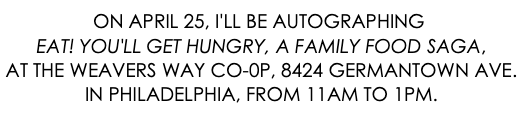
 Food, as you will find out in this book, has always been important to my family. Whether it was a routine weekday dinner, a holiday feast, or a post-funeral lunch, food was the glue that held everything and everybody together. One of the biggest meals in memory was provided to my immediate family by my aunts and cousins after we returned from my father’s funeral. It was as if the volume of food was designed to ease the hurt.
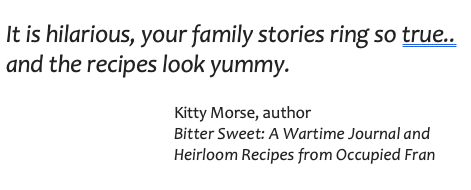 Anna Gugino, my mother, believed that if you were healthy, you ate. If you didn’t eat, you were sick or dead. So, for her the denial of food to anyone was cruel and unusual punishment. On those rare occasions when a guest – usually a non-Italian – would say they weren’t hungry, her instant response was “Eat! You’ll get hungry.”
This combination of death and eating is not uncommon with Italians. I have noticed, for example, that many Mafia chieftains, like Paul Castellano, Carmine Galante, and Joey “Crazy Joe” Gallo, have been gunned down in or outside restaurants. This, I believe, is the Italian equivalent of a Viking dying with a sword in his hand so that he may enter the kingdom of Valhalla.
Cooking and eating and talking about cooking and eating took up a lot of time in my family, as was the case with many Italian Americans. Some years ago, my brother Russell told me of having a very traditional Italian meal with a man who grew up eating the same foods we ate. While savoring his repast, he turned to my brother and said, “This is better than sex.” Perhaps this gives you an idea of the depth of feeling some Italians have for their cuisine. Since we never talked about sex in my family, I can only assume that we channeled those passions into our cooking and eating.
Although food dominated our lives, it never occurred to me that what we ate was of interest to anyone outside the family (which included the extended family of aunts, uncles, and cousins). As a matter of fact, I often felt embarrassed because we weren’t eating what other people were eating. And, as with most ethnic groups, it was important to assimilate. (I even wanted to change my name to something more “American.” My model was Stan Jones, a Hall of Fame lineman for the Chicago Bears. I thought Sam Jones sounded nice.) Sharing an artichoke with a fifth-grade classmate would not make this any easier.
There were a few incidents during my early years that made me think, however briefly, that maybe we weren’t the only ones who ate weird food. I was shoveling snow—something we often did in Buffalo, NY, where I grew up—off a neighbor’s driveway one Sunday to earn some pocket money. When I finished, I went inside to collect my fee. (In the 1950s and early 1960s, a shoveled backyard, driveway, and sidewalk could be had for the princely sum of $3.) Our neighbor was Jewish, as were many in the neighborhood before other Italians followed us. As I entered the kitchen, I was shocked to see my neighbor eating cold fish—probably smoked whitefish or herring. And it wasn’t even Friday!
But it wasn’t until I got to college that I really began to appreciate my culinary heritage. Perhaps nothing makes you yearn for good home cooking more than regular meals at a campus dining facility. Also, in talking to other people from diverse backgrounds, I came to realize just how boring some of their eating habits were. I recall sitting in the living room with a few fraternity brothers at the Delta Tau Delta fraternity house at the University of Pennsylvania. Somehow, the subject of food came up, and I began to talk about the foods we ate at home. Everyone listened with interest, and one person in particular, John Madden, was especially fascinated. A major reason for his keen interest was that his upper-class Anglo-Saxon background probably included little Italian food beyond pizza and spaghetti and meatballs.
The reaction of guests at our dinner table was another indicator of how special my family’s meals were. Because my brothers Frank and Russell attended colleges in central New York, they often brought classmates home. I can’t recall anyone who wasn’t bowled over by Mom’s cooking—both the quantity and quality. I think the feeling of warmth in our household was undeniable as well.
After twenty-one years of having someone else cook for me, I started to cook for myself when I was a senior in college and living in a townhouse with two roommates in Center City, Philadelphia. Faced with this new independence, I tried to figure out just where to begin. Then I remembered how Mom shopped and cooked. And little by little, I started to duplicate both. It wasn’t long before I was able to produce an entire Sunday spaghetti dinner that tasted exactly like Mom’s.
After graduation in 1970, I continued to get serious about cooking. During my frequent visits to Washington, DC, where Frank lived, we often talked about the lack of good Italian restaurants, as well as delis and shops that sold Italian food products, especially in Washington. We fantasized about opening our own alimentaria. Alas, in early 1975, like Frost’s poem “The Road Not Taken,” Frank took the more traveled road and stayed with his sales job. With the encouragement and support of my wife, Mary, whose birthday present to me a year earlier was my first cooking class, I took the road less traveled. I left my insurance job and entered The Restaurant School in Philadelphia, which had opened the year before.
Those were heady times for food and wine across the country. Alice Waters started her legendary restaurant, Chez Panisse, in 1971. Lawyers, doctors, teachers, and the like were leaving their conventional jobs and going into the restaurant business. (Waters was a former Montessori teacher. Her first chef, Jeremiah Tower, was an architect.)
The Restaurant School broadened my culinary horizons dramatically. Following graduation, I operated two critically successful restaurants as chef and manager. A Philadelphia Inquirer review of my first restaurant, Vincenzo’s, was titled “Where they serve the best Italian food.” After stints with two hotels as a food-and-beverage manager, I began writing seriously in 1983.
Back in 1981, again with Mary’s encouragement, I took a humor writing course at Temple University taught by Art Milner. It was there that I wrote a story called, “Eat … You’ll Get Hungry,” which was about family dinner in the Gugino household. Art suggested that I concentrate on the three topics contained in that piece—food, family, and humor.
I developed most of my early stories from memory. I have always had a facility for remembering trivia. This came in handy on multiple-choice tests in school, where the instant recall of state capitals was thought to be important. It was also invaluable in thinking of the details contained in the family stories. Later, I picked the collective brains of my mother, my Aunt Sandy, Frank and Russ, and my sister, Maria.
The first published story in what I loosely referred to as the “Family Eating Saga” appeared in the Philadelphia Daily News on December 14, 1983. It was about Aunt Sandy’s cookies and was submitted as “Have a Cookie.” But like 90 percent of my titles, it was changed by a copy editor and became “The Ghost of Cookies Past” because of its nostalgia and because it ran during the Christmas season. Subsequent articles appeared periodically over the next few years in the Daily News and the San Jose Mercury News, where I was food editor from 1989 to 1994. Some of the stories have been modified for this book, and many have new recipes added to them.
After several attempts at making Eat! You’ll Get Hungry a reality, I finally made headway during and after the pandemic of 2020. I was also encouraged by my brother Frank, who, with no experience, wrote Man of Salt, a pretty darned good historical novel. And so, with the help of nieces, nephews, and cousins, who tested some of the recipes (and whose names appear in the Acknowledgments), here is, at last, Eat! You’ll Get Hungry.
Recipes from Eat! You’ll Get Hungry.
Here are three recipes from the book. We normally ate the olive salad with cold cuts or leftovers after a big afternoon holiday meal. The Sicilian lamb stew is great on a chilly winter evening, especially if you’ve got a leftover ham bone. The giuggiuleni are one of my Aunt Sandy’s many great cookies.
Where to buy Eat! You’ll get Hungry.
- Barnes & Noble (ebook and print)
- Apple (ebook)
- Kobo (ebook)
- Books-a-Million (print)
- Amazon (print)